Basement Flooding Cleanup in Marietta, GA
Fast Water Removal, Complete Drying, and Honest Answers About Why It Happened.
A flooded basement is stressful, and if it has happened before, it is even more frustrating. We get the water out and dry your basement fast, and we tell you honestly why it flooded, so you can stop it from happening again. Call now and a live crew is on the way.
Flooded Basement? What to Do Right Now
A flooded basement is one of the most dangerous places in your home because water and electricity meet below ground. Safety comes first. Follow these steps and stay off the basement floor until you know it is safe.
- Do not go down into the water. Stop on the stairs. Standing water in a basement can be charged by outlets, appliances, or the electrical panel.
- Turn off power and gas to the basement at the main panel first, but only if you can reach it without stepping in water.
- If you cannot safely shut off the power, stay out and wait for our crew or an electrician.
- Notice whether the water smells like sewage. If it does, treat it as contaminated and keep everyone away.
- If you can safely reach the source, like a burst pipe or a failed sump pump, and shut it off, do so.
- Take photos from the stairs for your insurance claim.
- Call us. We arrive with pumps, protective gear, and the equipment to make it safe.
Why Does Your Basement Flood, Especially When It Rains?
Here is the answer most homeowners never get. Your basement sits below ground, surrounded by soil on every side. When heavy rain saturates that soil, the water has to go somewhere, and it pushes against your foundation. This force is called hydrostatic pressure, and it forces water through tiny cracks, gaps around pipes, and even through solid concrete, which is more porous than it looks.
Think of it like a boat sitting in a pond. When the water outside rises higher than your basement floor, your basement is the boat, and water leaks in through any crack or seam it can find. That is why you often see water coming up through the floor or in through the seam where the wall meets the floor, not just running down a wall.
In Marietta, the clay soil makes it worse. Red clay holds water instead of draining it, forming a soggy "clay bowl" around your foundation after a storm. That clay also expands when wet and shrinks when dry, and over years that constant movement cracks foundations and opens new paths for water. This is why the same basement floods again and again every time it rains hard. The cause is still there.
Marietta's Local Basement Flooding Team
Marietta Restoration Experts is a locally owned basement flooding cleanup company serving Marietta and Cobb County since 2013. We remove the water, dry your basement fully, and handle any repairs, but we also do what most cleanup companies will not: we tell you the real reason your basement flooded. Whether the water came up through the floor from hydrostatic pressure, poured in through a foundation crack, or backed up through a drain, our IICRC-certified crew handles the cleanup and gives you a straight answer about what to fix next.
Call for Immediate Help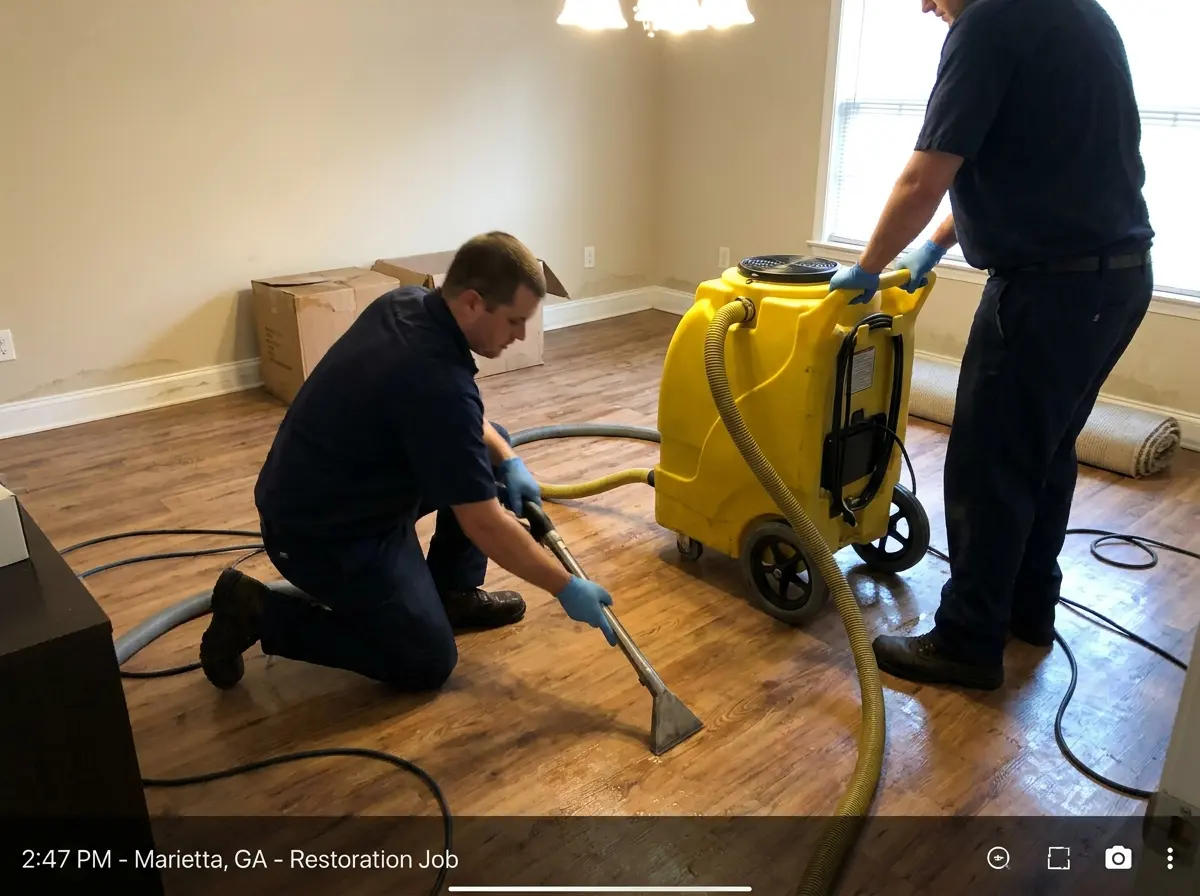
What Causes Basement Flooding in Marietta Homes
After more than ten years working in Cobb County basements, these are the causes we find most.
The most common cause. Saturated clay soil presses against your foundation and forces water through cracks and porous concrete, often up through the floor or the seam where the wall meets the floor.
The cold joint, where the foundation wall meets the floor slab, is a natural weak point. Combined with cracks from Marietta's shifting clay soil, it gives water a direct path in during heavy rain.
A sump pump can fail during a power outage in a storm, exactly when you need it, or simply wear out. Many older Marietta homes have no sump pump at all, so groundwater has nothing stopping it.
Clogged gutters, downspouts that dump right next to the foundation, and yards graded toward the house all send rainwater straight down to your basement walls instead of away from them.
Basement window wells collect water in heavy rain, and once they fill past the window, water pours straight in.
During heavy storms, an overwhelmed sewer can push wastewater up through a basement floor drain. This is contaminated water and needs sewage backup cleanup.
Not every basement flood comes from outside. A burst pipe or a failed water heater in the basement can flood it from the inside just as fast.
Is Your Basement Water Clean or Contaminated?
Not all basement flood water is the same, and the difference decides how the cleanup is handled and how safe it is to be near.
Usually cleaner
Groundwater seepage. Rainwater pushed in through cracks and the floor is usually cleaner, but sitting water still grows bacteria and mold within a day or two.
Contaminated — keep everyone away
Sewer backup. Water that comes up through a floor drain during a storm is contaminated black water. It carries bacteria and needs biohazard handling, protective gear, and full disinfection.
Cleanup vs Waterproofing: What You Actually Need
This is the honest part most cleanup companies skip. There are two different jobs, and knowing which you need saves you money and stress.
Cleanup and Drying (what we do)
We remove the water, dry the structure, treat for mold, and restore what was damaged. This stops the immediate damage and makes your basement safe and usable again. If the flood was a one-time event, like a burst pipe or a failed sump pump you have since replaced, cleanup is all you need.
Waterproofing (what may be needed to stop it returning)
If the cause is hydrostatic pressure and your clay soil, cleanup alone will not stop it from happening again. Stopping recurring floods takes a drainage system, a working sump pump with battery backup, foundation crack repair, or exterior waterproofing. That is a separate job from cleanup.
How We Clean Up a Flooded Basement
Here is how we work once we arrive. For the full step-by-step detail, see our restoration process.
We confirm the power is off and check for electrical and contamination hazards before entering the water.
Submersible pumps and truck-mounted extractors remove standing water fast, even several inches or feet of it.
Soaked carpet, padding, and drywall that cannot be saved are removed, especially if the water was contaminated.
Below-grade spaces dry slowly, so we use commercial dehumidifiers and air movers and check moisture daily.
If the water was contaminated, we disinfect all affected surfaces with EPA-approved products.
We restore what was removed and tell you what caused the flood and what it will take to prevent the next one.
How to Stop Your Basement From Flooding Again
If hydrostatic pressure and drainage are the cause, these steps lower your risk of the next flood. Some you can do yourself, and some need a professional.
- Clean your gutters. Clogged gutters overflow at the foundation, feeding the clay bowl around your basement.
- Extend your downspouts. Run downspouts at least four to six feet away from the house so rainwater does not pool against the foundation.
- Fix your grading. The ground should slope away from your home. Soil that slopes toward the house sends water straight to the basement.
- Install or maintain a sump pump. A working sump pump with a battery backup keeps running during the power outages that come with big storms.
- Cover window wells. Window well covers keep rain from collecting and pouring through basement windows.
- Seal foundation cracks. Have cracks repaired properly. Plastering over them is a temporary fix that does not hold against pressure.
How Much Does Basement Flooding Cleanup Cost in Marietta?
Basement flooding cleanup in Marietta usually costs $1,500 to $6,000 for most homes. A small amount of clean water on a concrete floor costs less, while a deeply flooded finished basement with contaminated water costs more. The final price depends on how much water there was, whether the basement is finished, how much material has to be removed, and the drying time needed.
A finished basement with carpet, drywall, and belongings costs more than a bare concrete one.
Deeper water and sewage backup mean more removal, disinfection, and disposal costs.
Below-grade spaces dry slowly, and Marietta humidity extends it, which adds equipment days.
Flooded Basement in Marietta?
Call (770) 796-7192 — We Answer Live, Day and NightBasement Flooding FAQs
Basement Flooding Cleanup Across Marietta and Cobb County
We respond to basement flooding across Marietta and every town around it. Wherever you are in Cobb County, our nearest crew is close by.
- East Cobb basement flooding cleanup
- Kennesaw basement flooding cleanup
- Smyrna basement flooding cleanup
- Acworth basement flooding cleanup
- Powder Springs basement flooding cleanup
We serve neighborhoods including Indian Hills, Whitlock Heights, East Park, Chestnut Creek, Windsor Oaks, Chimney Springs, Somerset, and communities across Marietta and Cobb County.
ZIP codes covered: 30006, 30007, 30008, 30060, 30062, 30064, 30066, 30067, 30068, and 30090.
Call Now. We Get the Water Out Fast.
Whether it is the first time or you are tired of it happening again, we get the water out, dry your basement, and tell you straight what it will take to keep it dry. Our local crew answers live, day or night, and reaches you in 60 minutes.
(770) 796-7192 | Available 24/7, including weekends and holidays